Dog Life Expectancy Calculator
A population-level estimate of how many years your dog is likely to have left — anchored in breed median lifespan, adjusted by current age, weight, and body condition.

How this calculator works
RVC VetCompass breed median as base; adjusted by weight percentile and age percentile.
How this calculator works
Four components: breed median, age elapsed, body condition adjustment, within-breed weight percentile. Each is a published observational signal; combined they give a population-level estimate.
- 1
base = breedMedianLifespan
RVC VetCompass publishes breed-specific lifespan medians from a cohort of roughly 585,000 UK primary-care veterinary records. That median is the starting point.
McMillan KM et al., Scientific Reports 2024.
- 2
yearsRemaining = base − currentAge
A population-level subtraction. This says nothing about any specific dog — individual variation is wide — but it is the defensible first approximation.
RVC VetCompass 2024.
- 3
adjustBCS = over-weight reduces expected years
Kealy 2002 (Labrador restriction trial) and Salt 2019 both show a dose-response relationship between BCS and lifespan. Overweight shortens, obese shortens more.
Kealy et al. 2002 JAVMA; Salt et al. 2019 JVIM.
- 4
adjustWeight = weight-percentile-within-breed correction
Within a breed, dogs at the top of the weight range tend to have shorter expectancies than dogs sitting at or below the breed median weight.
Observational; RVC VetCompass breed summaries.
When to use this calculator
Use this when you're planning for senior care, scheduling preventive screening intervals, or making longer-term decisions about insurance, gear, or travel. The number is a planning anchor, not a prediction about your specific dog.
Pair the output with the Senior Threshold calculator to see when the life-stage transition actually happens for your breed, and with the Weight calculator to see whether body condition is nudging the estimate in either direction.
Frequently asked
Is life expectancy accurate for an individual dog?
No — it is a population-level estimate. Individual variation within any breed is wide, driven by genetics, care, environment, and luck. Use the number as an anchor for planning (senior care, preventive screening cadence), not as a prediction of exactly how long your specific dog will live.
Why does body condition reduce expected years?
Kealy et al. (2002) ran a 14-year Labrador cohort study where half the dogs ate 25% less than the control group. The diet-restricted group lived roughly 1.8 years longer on average. Across multiple follow-up studies the finding is consistent: staying at an ideal body-condition score extends expected lifespan.
What if my breed isn't in RVC VetCompass?
We fall back to AKC breed-standard lifespan ranges, or to size-category averages if neither is available. Selecting a breed gives the most precise number; leaving breed blank just drops the precision band.
Related calculators
- Dog age
Dog Age Calculator
The flagship: breed- and size-aware dog-to-human age conversion, built on the UCSD 2019 epigenetic clock.
Open calculator - Weight
Dog Weight Calculator
Ideal adult weight by breed and frame, plus a body-condition-score lookup.
Open calculator - Food
Dog Food Calculator
Daily cup and gram portions by weight, activity level, and life stage.
Open calculator
Related reading
- Pillar guide
Why Small Dogs Live Longer Than Big Dogs
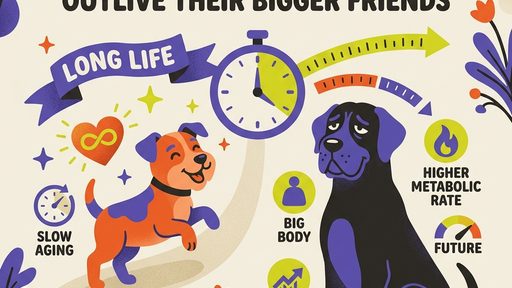
Across mammals, bigger animals live longer. Within the domestic dog, the rule reverses sharply. The mechanism involves IGF-1, selected growth rates, and cancer scaling — and Kraus et al. (2013) decomposed it.
Read guide - Comparison

Dog Life Expectancy Factors: What Actually Moves the Needle
A ranked accounting of the factors that influence canine lifespan — what's modifiable, what isn't, and which levers the peer-reviewed research supports.
Read guide - Comparison
Dog Breeds by Lifespan, Ranked (RVC VetCompass)
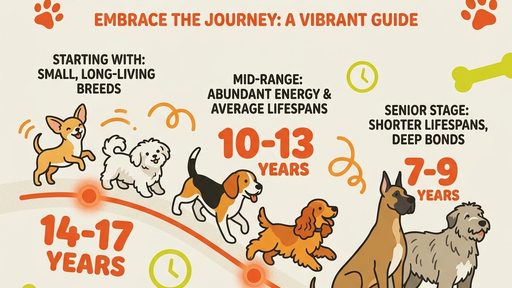
The definitive ranked reference for canine breed lifespan — 136 manifest-covered breeds with RVC VetCompass medians, organized by overall rank and by size category.
Read guide


Sources
The formula and life-stage logic on this page cite the peer- reviewed research and veterinary-organization guidelines below.
- VetCompass · 2024McMillan KM et al. — Life tables of annual life expectancy and mortality
Breed-specific median lifespans that anchor the calculator.
- Peer-reviewed · 2002Kealy RD et al. — Effects of diet restriction on life span and age-related changes in dogs
14-year Labrador cohort — source of the BCS-to-lifespan link.
- Peer-reviewed · 2019Salt C et al. — Association between life span and body condition in neutered client-owned dogs
Broader follow-up confirming BCS-lifespan relationship across breeds.
- Peer-reviewed · 2022Teng KT et al. — Life tables of annual life expectancy for companion dogs in the UK
UK-wide breed life-tables used to fill gaps in coverage.