Dog Age Calculator
Enter your dog's age and size — or pick a breed — and get the human-age equivalent on three scales: UCSD epigenetic, AVMA size-adjusted, and life-stage classification.

How this calculator works
UCSD 2019 (Wang et al.) epigenetic clock as the base; AAHA life-stage adjustment applied by size category.
How this calculator works
Three formulas work in parallel on this page — each answers a slightly different version of the question. UCSD is the closest to what the biology actually looks like; AVMA is the intuitive size-adjusted reference; Fortney gives you the veterinary life-stage label.
- 1
ucsd = 16 × ln(dogAge) + 31
Wang et al. 2019 derived this from DNA-methylation patterns across ~300 Labrador Retrievers. The log shape reflects the reality that puppies age fast and old dogs age slow — not a linear 7× multiplier.
Wang T et al., Cell Systems 2020 (UCSD).
- 2
avma = sizeAdjust(dogAge)
AVMA guidance adds size adjustment: first year = 15 human years, second = 9, then 4 (small) / 5 (medium) / 6 (large) / 7 (giant) per year. Coarser than UCSD but intuitive for owners.
AVMA Senior Pet Care Guidelines, 2021.
- 3
lifeStage = fortney(dogAge, size)
Fortney 2012 size-category thresholds translate the raw age into a life stage — puppy, adolescent, adult, senior, or geriatric. Giant dogs hit senior at 5 while toy dogs do not until 9.
Fortney WD, Topics in Companion Animal Medicine 2012.
- 4
breedPercentile = dogAge / breedMedianLifespan × 100
When a breed is selected, we also surface where the dog sits relative to that breed's typical median lifespan (RVC VetCompass where available).
McMillan et al., RVC VetCompass 2024.
When to use this calculator
Any time you want the real answer to "how old is my dog in human years." The calculator is most useful when you've selected a breed (or know the size category), since that's where the mapping tightens up.
For a 7-year-old Golden Retriever, the UCSD clock lands in the mid- to late-60s in human terms — the dog is entering senior territory. A 7-year-old Toy Poodle, by contrast, is still a solid adult. The calculator surfaces both.
Frequently asked
Is the seven-year rule wrong?
It is a folk approximation. Dogs mature dramatically in their first two years — roughly 15 and 24 human years — then slow. Epigenetic evidence shows the mapping is logarithmic, not linear; the seven-year rule overstates dog-age at the young end and understates it at the old end.
Why does breed size matter?
Large dogs age faster than small dogs. A 5-year-old Great Dane is roughly equivalent to a senior human; a 5-year-old Chihuahua is still squarely in adulthood. This calculator adjusts for that by size category and — when a breed is selected — breed-specific lifespan data.
Where does the UCSD formula come from?
Wang et al. (2019) measured DNA methylation across roughly 300 Labrador Retrievers and compared to a human methylation clock. The resulting mapping, 16 × ln(dog_age) + 31, is currently the most precise age-translation formula available and became the spine of this site's age math.
Related calculators
- Weight
Dog Weight Calculator
Ideal adult weight by breed and frame, plus a body-condition-score lookup.
Open calculator - Food
Dog Food Calculator
Daily cup and gram portions by weight, activity level, and life stage.
Open calculator - Calories
Dog Calorie Calculator
Resting and active daily calorie needs, computed from weight and activity factor.
Open calculator
Related reading
- Pillar guide
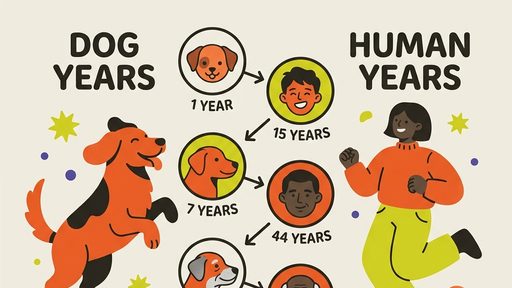
How Old Is My Dog in Human Years? The 2026 Answer
The seven-year rule was never right. Here is what the UCSD epigenetic clock, RVC life tables, and size-adjusted math actually say — by breed and stage.
Read guide - Pillar guide
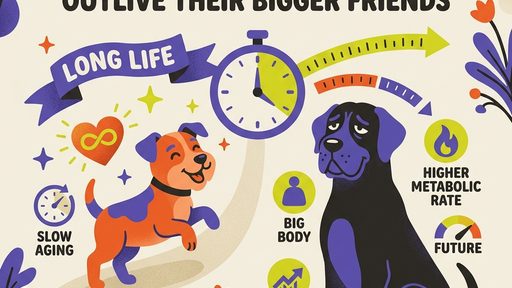
Why Small Dogs Live Longer Than Big Dogs
Across mammals, bigger animals live longer. Within the domestic dog, the rule reverses sharply. The mechanism involves IGF-1, selected growth rates, and cancer scaling — and Kraus et al. (2013) decomposed it.
Read guide - Pillar guide
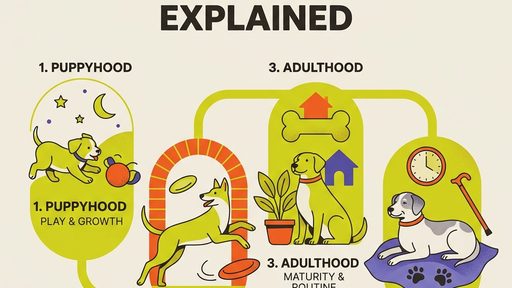
The Six Dog Life Stages, Explained
Puppy to geriatric, per the AAHA 2019 framework — with size-specific thresholds. The terminology every vet uses, translated for owners.
Read guide


Sources
The formula and life-stage logic on this page cite the peer- reviewed research and veterinary-organization guidelines below.
- Peer-reviewed · 2020Wang T, Ma J, Hogan AN et al. — Quantitative Translation of Dog-to-Human Aging by Conserved Remodeling of the DNA Methylome
Source of the UCSD 2019 epigenetic clock: 16 × ln(dog_age) + 31.
- Veterinary guideline · 2021American Veterinary Medical Association — Senior Pet Care Guidelines
Source of size-adjusted AVMA year multipliers.
- Peer-reviewed · 2012Fortney WD — Implementing a Successful Senior/Geriatric Health Care Program (Topics in Companion Animal Medicine)
Size-category senior / geriatric thresholds used for the life-stage label.
- VetCompass · 2024McMillan KM et al. — Life tables of annual life expectancy and mortality for companion dogs in the United Kingdom
Breed median lifespans that power the breed-percentile calculation.