Dog Age Calculator
Enter your dog's age and size - or pick a breed - and get the human-age equivalent on three scales: UCSD epigenetic, AVMA size-adjusted, and life-stage classification.

How this calculator works
Wang et al. 2020 Labrador-based age mapping, shown separately from size and life-stage references. Not a DNA test.
How this calculator works
The equation came from a study of 104 Labrador Retrievers, published in Cell Systems in 2020 after a 2019 preprint. Displaying it alongside other references does not validate a combined biological-age model for all breeds.
- 1
ucsd = 16 × ln(dogAge) + 31
Wang et al. (2020, following a 2019 preprint) derived this from DNA-methylation patterns across 104 Labrador Retrievers. The log shape reflects the reality that puppies age fast and old dogs age slow - not a linear 7× multiplier.
Wang T et al., Cell Systems 2020 (UCSD).
- 2
avma = sizeAdjust(dogAge)
AVMA guidance adds size adjustment: first year = 15 human years, second = 9, then 4 (small) / 5 (medium) / 6 (large) / 7 (giant) per year. Coarser than UCSD but intuitive for owners.
AVMA Senior Pet Care Guidelines, 2021.
- 3
lifeStage = fortney(dogAge, size)
Fortney 2012 size-category thresholds translate the raw age into a life stage - puppy, adolescent, adult, senior, or geriatric. Giant dogs hit senior at 5 while toy dogs do not until 9.
Fortney WD, Topics in Companion Animal Medicine 2012.
- 4
age / breedReference × 100
When a breed is selected, age is divided by its labelled lifespan reference. This percentage is not a survival percentile or a prediction of lifespan.
McMillan et al. 2024, Table S3.
When to use this calculator
Use the results as educational comparisons. The same calendar age gives the same Wang equation result for every breed; a separate size-based reference and life-stage label offer additional context. No DNA sample is measured.
Frequently asked
Is the seven-year rule wrong?
It is a folk approximation. Dogs mature dramatically in their first two years - roughly 15 and 24 human years - then slow. Epigenetic evidence shows the mapping is logarithmic, not linear; multiplying by seven generally understates the mapped human-age value in early life. Neither shortcut measures an individual dog’s health.
Why does breed size matter?
The site’s size-based reference uses different age multipliers for different size categories. This is a heuristic comparison, not proof that an individual dog has reached a particular human biological age. The size-based comparison and breed reference are separate from the Labrador-derived equation; selecting a breed does not modify that equation.
Where does the UCSD formula come from?
Wang et al. (2020) studied DNA methylation across 104 Labrador Retrievers and compared to a human methylation clock. The resulting mapping, 16 × ln(dog_age) + 31, is used here as an educational comparison. This calculator does not measure DNA methylation, and the Labrador-derived equation is not validated here as an individual biological-age test for every breed.
Related calculators
- Weight
Dog Weight Calculator
Ideal adult weight by breed and frame, plus a body-condition-score lookup.
Open calculator - Food
Dog Food Calculator
Convert a calorie estimate or your supplied daily target to cups and grams using your food label.
Open calculator - Calories
Dog Calorie Calculator
Resting and active daily calorie needs, computed from weight and activity factor.
Open calculator
Related reading
- Pillar guide
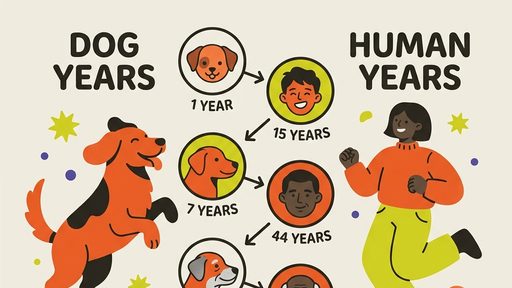
How Old Is My Dog in Human Years? The 2026 Answer
The seven-year rule was never right. Here is what the UCSD epigenetic clock, RVC life tables, and size-adjusted math actually say — by breed and stage.
Read guide - Pillar guide
Why Small Dogs Live Longer Than Big Dogs
Across mammals, bigger animals live longer. Within the domestic dog, the rule reverses sharply. The mechanism involves IGF-1, selected growth rates, and cancer scaling — and Kraus et al. (2013) decomposed it.
Read guide - Pillar guide
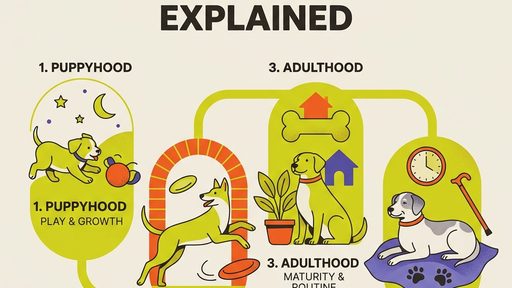
The Six Dog Life Stages, Explained
Puppy to geriatric, per the AAHA 2019 framework — with size-specific thresholds. The terminology every vet uses, translated for owners.
Read guide


Sources
The formula and life-stage logic on this page cite the peer- reviewed research and veterinary-organization guidelines below.
- Peer-reviewed · 2020Wang T, Ma J, Hogan AN et al. - Quantitative Translation of Dog-to-Human Aging by Conserved Remodeling of the DNA Methylome
Source of the Wang 2020 Labrador-based age mapping: 16 × ln(dog_age) + 31.
- Veterinary guideline · 2021American Veterinary Medical Association - Senior Pet Care Guidelines
Source of size-adjusted AVMA year multipliers.
- Peer-reviewed · 2012Fortney WD - Implementing a Successful Senior/Geriatric Health Care Program (Topics in Companion Animal Medicine)
Size-category senior / geriatric thresholds used for the life-stage label.
- Peer-reviewed · 2024McMillan et al. - Longevity of companion dog breeds: those at risk from early death
Breed medians for the age/reference percentage. This is not a survival percentile.